
- Your cart is empty
- Continue Shopping

About CCTV Cameras STQC (Standardization Testing and Quality Certification) & BIS Bureau of Indian Standards
- Posted on
-
Posted by: scycctvworld
- 0 comments
- Categories: Blog
STQC and BIS are two government-backed certification systems in India that ensure electronic and surveillance products meet strict standards for safety, reliability, and compliance. For CCTV and IT products, both certifications are now mandatory, especially after April 1, 2026.
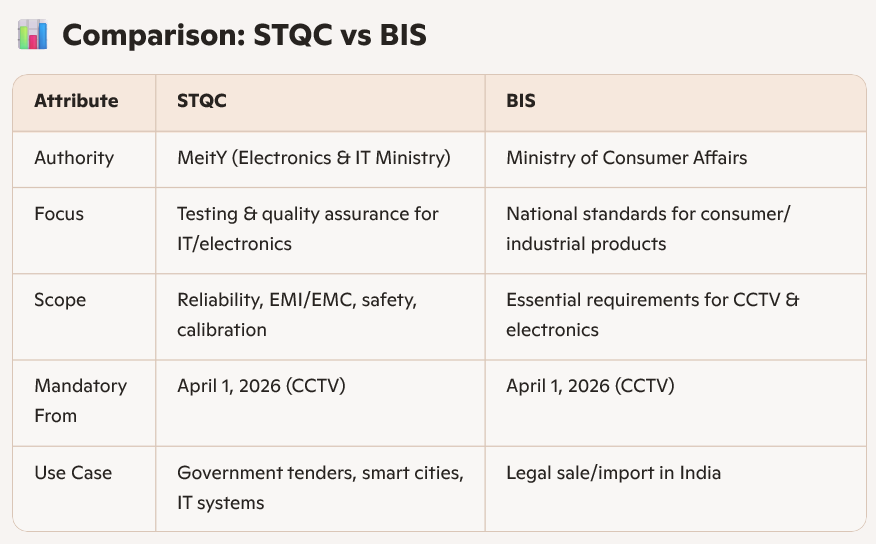
📌 STQC (Standardisation Testing and Quality Certification)
- Authority: Directorate under the Ministry of Electronics & IT (MeitY).
- Established: Early 1980s.
- Purpose: Provides quality assurance services for IT and electronic products.
- Scope of Testing:
- Electronics & electrical systems
- Environmental and safety testing
- EMI/EMC (electromagnetic compatibility)
- Reliability analysis
- Calibration services
- Ensures products are secure, reliable, and standardized.
- Mandatory for CCTV cameras and IT systems used in government projects, smart cities, and regulated industries.
- From April 1, 2026, CCTV cameras without STQC compliance cannot be sold in India.
📌 BIS (Bureau of Indian Standards)
- Authority: Ministry of Consumer Affairs, Government of India.
- Purpose: Sets national standards for consumer and industrial products.
- Certification for CCTV:
- Known as BIS-ER (Essential Requirements) certification.
- Ensures CCTV cameras meet performance, safety, and interoperability standards.
- Why It Matters:
- As of April 1, 2026, BIS certification is compulsory for all CCTV cameras sold or imported in India.
- Without BIS, products cannot legally enter the Indian market.
⚠️ Key Takeaway
- Both STQC and BIS are mandatory for CCTV cameras in India from April 1, 2026.
- STQC ensures technical reliability and compliance for government projects.
- BIS ensures consumer safety and legal compliance for sale/import.
best cctv cameras, bis, CCTV cameras, chittoor, how to find top cctv cameras, madanapalli, nellore, ongole, stqc, tirupati
